
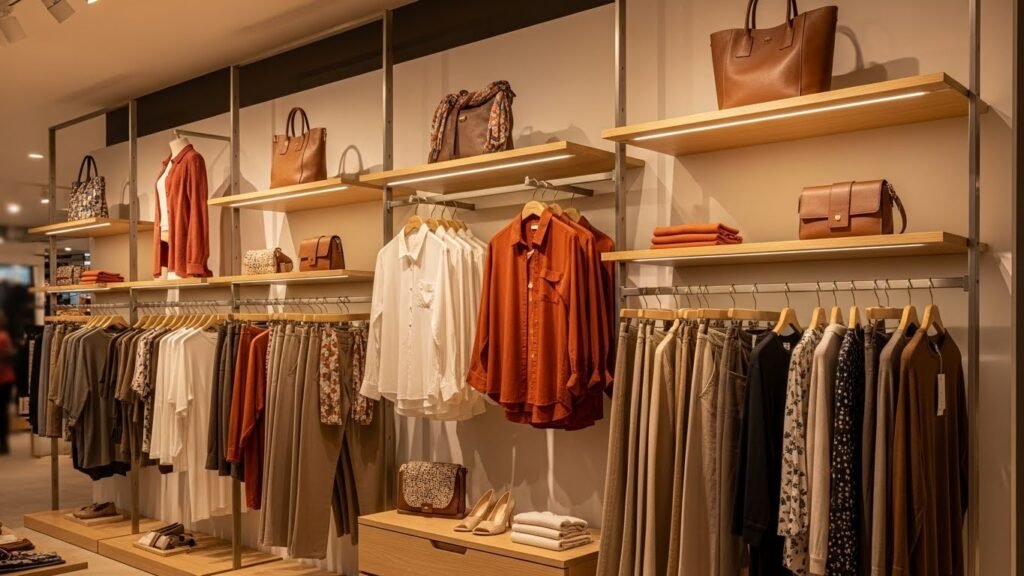
Are you struggling with slow store rollouts and sky-high manufacturing costs? These delays eat your profits and stall your brand growth. My universal component strategy fixes these problems immediately.
A universal component strategy uses standardized internal parts to speed up production and assembly. By using common uprights and brackets, you cut design time, reduce shipping costs by 80% through knock-down packaging, and ensure faster, error-free store installations every single time.

I have spent years on the factory floor and running my own company. I have seen how custom designs can slow everything down. You want your stores to open fast, and I want my production line to run smoothly. This is why we need to talk about how we build your display fixtures and bespoke shopfittings. I will show you why the "start from scratch" method is costing you a fortune and how we can do better together.
How does standardization eliminate the "design-from-scratch" bottleneck?
Starting every project from zero creates a massive delay in your timeline. Your design team spends weeks on details that do not add value to the customer experience. This creates a bottleneck that stops your production before it even begins.
Standardization eliminates the "design-from-scratch" bottleneck by providing a library of pre-engineered components. Instead of re-inventing the wheel, we use proven structural parts. This allows factories to skip long tool-making phases, move straight to production, and reduce the risk of manufacturing errors significantly.

When I work on a project, I always look for ways to avoid "special" parts. In my experience, most projects lose time during the early design and sample confirmation stage. If you need a unique metal shape, a mold can take 5 to 15 days to make and cost up to $1,000. However, for smaller orders under 50 sets, I use laser cutting for tubes and plates. It is faster and avoids mold costs entirely.
If we use universal internal structures like standard uprights or shelf supports, we do not have to wait for new technical drawings. My factory can start buying materials and setting up machines immediately. For prototypes, I often use 3D printing for complex parts. We can print in plastic or even metal like stainless steel and aluminum within 12 to 36 hours. This lets you test the "look and feel" without waiting weeks for a factory sample.
| Production Method | Lead Time | Cost Impact | Best For |
|---|---|---|---|
| Traditional Molds | 5-15 Days | $100 - $1000 | High Volume (500+ sets) |
| Laser Cutting | 1-2 Days | Low (No Tooling) | Small to Mid Volume |
| 3D Printing (Metal/Plastic) | 12-36 Hours | Moderate | Prototypes & Testing |
| Universal Components | 0 Days | Very Low | All Volume Levels |
Where are the hidden cost savings in a modular manufacturing model?
Many designers think custom means "built as one piece," but this is a very expensive mistake. Fully assembled fixtures take up massive space in shipping containers and are easily damaged. You are paying to ship air across the ocean.
The hidden cost savings in modular manufacturing come from reduced shipping volume and lower labor costs. Knock-down (KD) designs can save 50% to 80% of container space. Additionally, modular parts allow for faster production runs in Asia, where labor is more cost-effective than in the USA or Europe.

I always suggest designing display fixtures as knock-down (KD) units. If we ship a fully assembled cash wrap or heavy display, we have to use huge wooden crates with lots of padding. This is very expensive. By using modular components, we fit more units into one container. I have seen projects where KD shipping saved a client enough money to pay for an extra store's worth of fixtures.
In high-labor-cost regions like the USA or EU, you want assembly to be simple. If a display takes three people all day to build, your costs explode. I design my universal components so one skilled worker can put them together quickly. Also, I keep stock of common parts like internal brackets in my factory. If a store needs a repair, I can ship a replacement part immediately rather than custom-making a single piece. This keeps your stores running without downtime.
| Shipping Method | Container Space | Protection Level | Local Labor Required |
|---|---|---|---|
| Fully Assembled | 100% (High Volume) | Harder to Protect | Low |
| Semi-Assembled | 60% Volume | Medium | Medium |
| Knock-Down (KD) | 20-30% Volume | Very High (Flat Pack) | Higher (but simplified) |
Can a "One-Size-Fits-All" framework still deliver a premium, localized brand experience?
You might worry that using standard parts will make your brand look cheap or "boring." You want your store to stand out, especially in luxury markets. The truth is that the "bones" can be standard while the "skin" stays unique.
Yes, a "One-Size-Fits-All" framework can deliver a premium experience by standardizing the internal structure while customizing the visible finishes. You use high-quality materials like real wood veneers or 2H hardness lacquered paints on a standard frame to achieve a luxury look without the custom price tag.

In my factory, we treat luxury projects differently than mass-market ones. For a luxury brand, we use at least two coats of primer and three coats of top lacquer. We work in dust-free, negative-pressure rooms to ensure the surface is perfect. If there is even one tiny air bubble, we sand it down and start over. We test the paint hardness with 2H pencils and use 75% alcohol to check for color fading. This level of quality is possible even if the internal metal frame is a standard design.
I also help clients choose the right materials for their location. For example, if you are using artificial stone (marble) on an MDF base, you must be careful. I know that MDF expands 30 times more than stone when the humidity changes. If your store is near an air conditioner or in the sun, the stone might crack. I solve this by using moisture-proof boards and leaving "expansion gaps" in the design. Whether we manufacture in China for the EU market or in Vietnam to save on North American tariffs, we maintain these high standards.
| Material Type | Best Use | Durability | Finish Quality |
|---|---|---|---|
| MDF (Medium Density) | Paint & Veneer | High (Smooth) | Premium/Luxury |
| Plywood | Structural Frames | Very High | Natural/Technical |
| Particleboard | Internal structures | Low to Medium | Budget/Mass Retail |
| Artificial Stone | Countertops | Very High | Luxury |
Conclusion
Standardizing your display fixtures and bespoke shopfittings is the fastest way to grow. You save time, cut shipping costs, and maintain a premium look while opening your stores much faster.


